
What Bosnia taught me about trust (and why it still applies in the Boardroom)
It was 1994. I was an acting Flight Lieutenant, newly arrived in Bosnia as a UK Liaison Officer. My team was three people: me, a Royal Marine driver, and a locally recruited interpreter. We lived out in the local communities with no base and no protective wire.
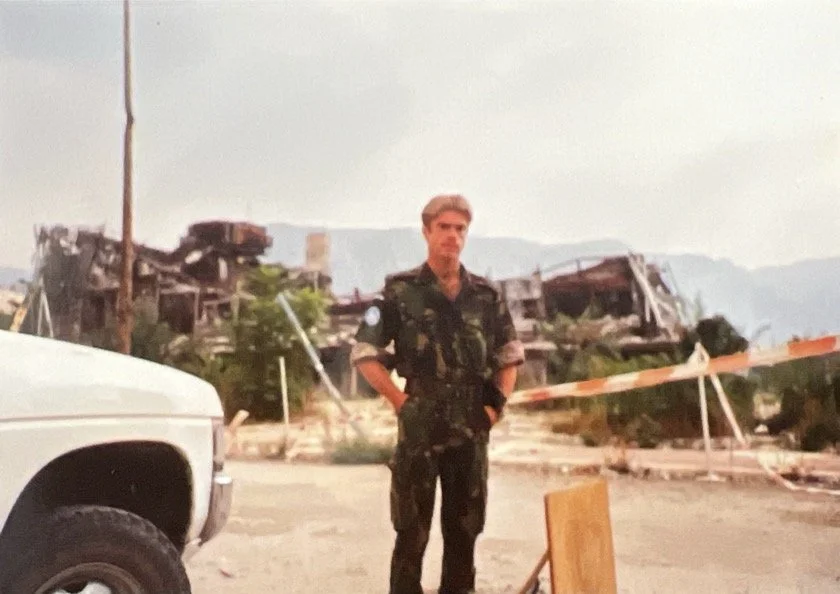
My job was to be the eyes and ears of the Multinational Sector Commander based in Gornji Vakuf. To go where he couldn't. To tell him what was actually happening on the ground, not the sanitised version that filtered up through official channels.
The problem was that the Bosnian Muslim Forward HQ I was liaising with didn't want to share anything. They were suspicious, guarded, and entirely rational in their distrust. Getting anything useful out of them took months of patient, persistent relationship-building before they'd lower their guard even slightly.
My final posting in theatre was Konjic, working with the Malaysian contingent. The complexity there was striking: three confrontation lines in a single area, a Croat enclave, a major Serb-Muslim line, and perhaps most challenging of all, Croats and Muslims trying to forge a working partnership under conditions of deep mutual distrust, with shells landing nearby as they attempted to do so.
I left before the worst of it. The sieges, the failures of UN peacekeeping that followed, the eventual NATO intervention; all well-documented. The lesson from that failure at the strategic level is sobering.
But the lesson I took at my level was different and I've applied it in every leadership role since.
Trust isn't one ingredient in team performance. It's the foundation everything else is built on.
When two parties are forced to work together but fundamentally don't trust each other, starting with the objective is a mistake. The objective is too far downstream. You have to start much further back.
Trust first. Then information begins to flow. Then genuine co-operation becomes possible. Only then do shared goals become achievable and only then does the objective have any real chance of being reached.
Patrick Lencioni mapped this with precision in The Five Dysfunctions of a Team. At the base of his pyramid sits the absence of trust, and every dysfunction that follows: fear of conflict, lack of commitment, avoidance of accountability, inattention to results - flows directly from it. You cannot shortcut trust and expect the upper layers to hold.
In my experience working with leadership teams, the trust piece is almost always the one that gets skipped.
I see its absence constantly. Post-merger integration where two leadership teams with different cultures are expected to function as one from day one. Joint ventures where the commercial logic is sound but the human groundwork hasn't been laid. Leadership teams that have been restructured and reorganised, new org chart, new reporting lines, same unresolved tensions underneath.
The strategy is clear. The org chart is tidy. But nothing moves, because the trust piece never got done.
The pressure to deliver results from a merger or restructure is immediate. Nobody wants to spend three months on relationship-building when the board is watching the synergy targets. And yet the organisations that skip the trust phase almost always pay for it later. In slower execution, higher attrition, and leadership friction that consumes far more time than the relationship-building would have taken.
Building trust deliberately isn't soft. It isn't a retreat away-day for its own sake. It's an investment in execution speed and decision quality. Teams that trust each other surface problems earlier, make faster decisions, and hold each other to higher standards. Not because they're told to, but because the foundation supports it.
The Croats and Muslims in Konjic were trying to build a partnership that ran against decades of history and deep mutual grievance, under pressure, with incomplete information and shells landing nearby.
If trust could be built in those conditions, it can be built in yours.
The question is whether you're treating it as the priority it actually is.
If your organisation is navigating a merger, restructuring, or team rebuild and you'd like to explore how to approach the trust piece deliberately, I'd be happy to have a conversation.
Get in touch at hello@davetait.co.uk