
Building the team
It doesn’t happen by accident
Strong teams don’t just appear.
They’re built over time, and with intent.
I think this is something many leaders underestimate. We often assume that if we get the right people in the room and give them a clear task, the rest will take care of itself.
Sometimes it does, for a while, but if you want a team that performs consistently, especially under pressure, you have to be more deliberate than that.
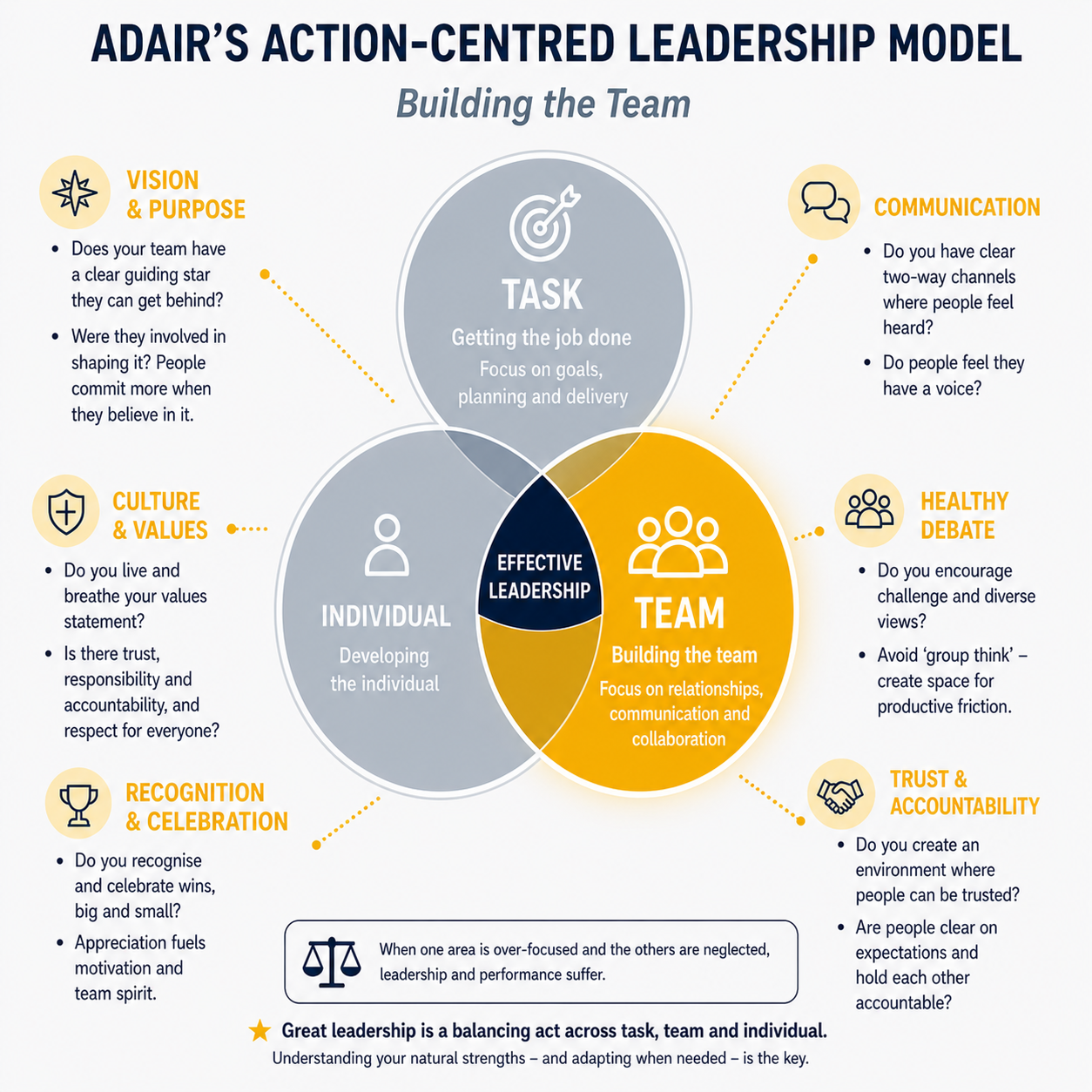
Start with direction
People need something to get behind. They need a clear, bright, guiding star.
A clear sense of where they’re going and why it matters.
That sounds obvious, but it’s surprising how often teams are working hard without really understanding the bigger picture.
Even more powerful is when they’ve been involved in shaping that direction. When people believe in what they’re doing, commitment changes. It stops feeling like work being done to them, and starts feeling like something they’re part of.
Culture is what actually shows up
You’ll hear the phrase “culture eats strategy for breakfast.” It’s overused but it’s true.
Culture isn’t what’s written on a wall. It’s what happens day to day.
It’s how people speak to each other, how decisions are made what gets rewarded and what gets ignored.
One of the simplest questions to ask yourself is:
Do we actually live our values?
Because if we don’t, the team will notice. And over time, trust starts to erode.
Communication and challenge
Good teams talk but great teams challenge.
If everyone is nodding along in agreement, you’ve probably got a problem.
Not because people agree but because they may not feel comfortable saying when they don’t.
Creating space for honest conversation takes effort. It means encouraging different views, asking for input, and sometimes sitting with a bit of discomfort.
I often think of it as productive friction. The kind that leads to better decisions and not conflict for the sake of it.
Trust, accountability and recognition
Trust sits at the heart of all of this.
Do people feel they can rely on each other?
Do they take responsibility for what they’ve said they’ll do?
Do they feel safe to speak up?
And just as importantly, do you recognise them when things go well?
It’s easy to move straight on to the next task but taking the time to acknowledge progress, effort and success (big or small) makes a difference. It builds momentum and reinforces what good looks like.
It’s a constant balance
Building a team isn’t a one-off activity. It’s ongoing and like everything in leadership, it’s about balance.
Too much focus on harmony, and you avoid the tough conversations.
Too much focus on challenge, and you risk damaging relationships.
The aim is somewhere in the middle, where people can challenge each other, but still leave the room aligned and pulling in the same direction.
If you’re thinking about your own team, a simple place to start:
Do people feel able to speak openly and do they know where they’re going together?
Get those two things right, and you’re a long way down the road.