
Balancing task, team and individual
Why self-awareness matters in leadership
On a recent leadership retreat, we spent some time exploring John Adair’s Action-Centred Leadership model.
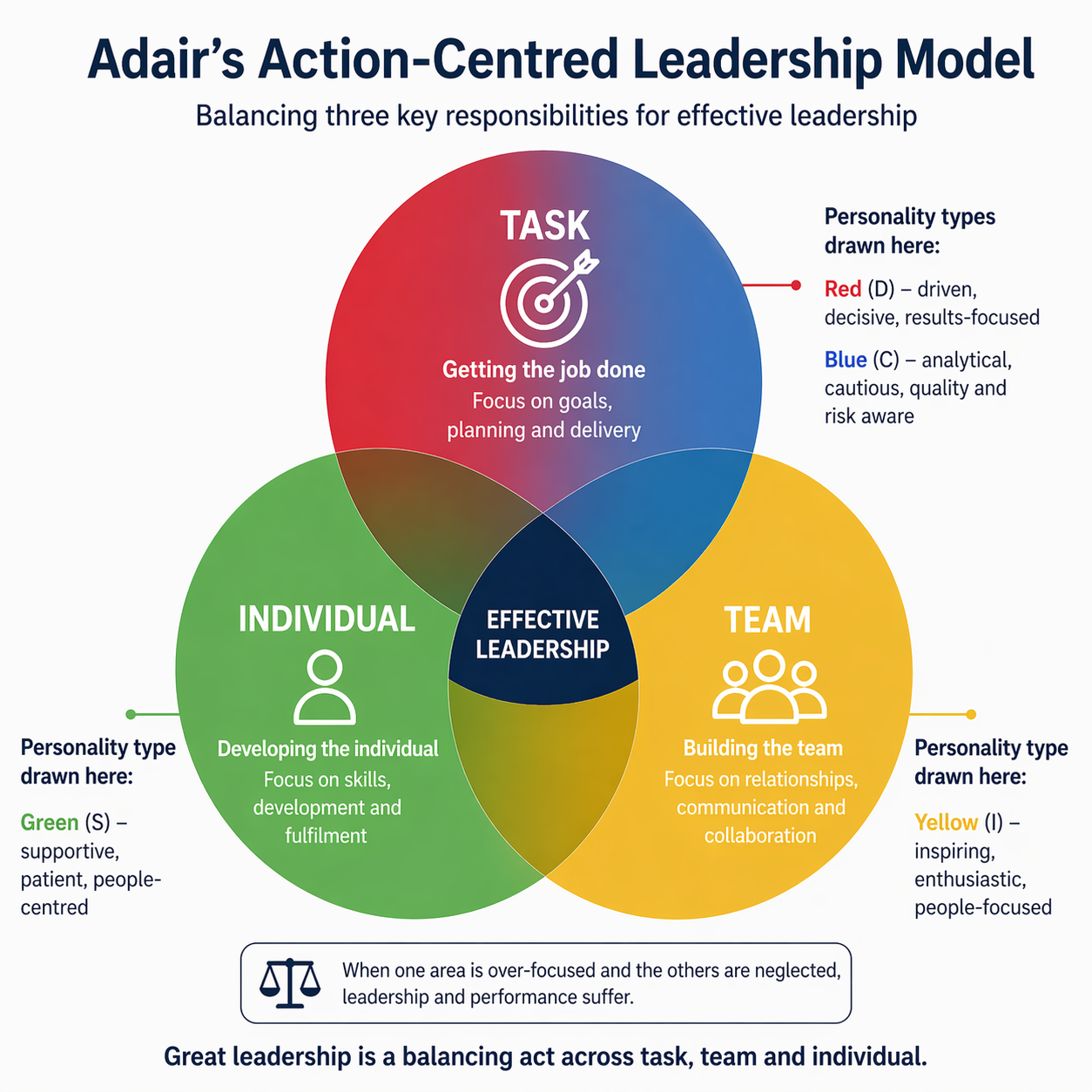
At its core, it’s simple. Leadership requires you to balance three things:
Delivering the task
Building the team
Developing the individuals within it
Get that balance right, and things tend to work. Get it wrong, and something usually gives.
What struck me (and the group) was how often leaders unintentionally lean too heavily into one area, often without realising it.
Where personality comes in
This is where personality plays a big part.
If you’re familiar with the DISC personality model, you’ll know that we all have natural preferences in how we lead and interact with others.
Those preferences often pull us towards one part of Adair’s model:
Dominance (Red) naturally task-focused
Drives delivery, makes decisions quickly but can push too hard and risk burnoutInfluence (Yellow) naturally team-focused
Brings energy, vision and connection but can lose focus on executionSteadiness (Green) naturally individual-focused
Builds strong relationships and trust but may avoid difficult conversationsConscientiousness (Blue) also task-focused (with a strong self-management element)
Brings analysis, quality and risk awareness but can overthink and delay decisions
None of these are wrong. In fact, all of them are valuable and many of us are a mix of two or three personality types!
Left unchecked, however, each one can become a weakness.
The real challenge: knowing your default
The key isn’t trying to be someone you’re not.
It’s understanding your natural tendency then adjusting your style when the situation requires it.
If you’re highly task-focused, you may need to slow down and bring people with you.
If you’re people-focused, you may need to sharpen your focus on delivery.
If you avoid conflict, you may need to lean into it.
If you over-analyse, you may need to decide and move.
That awareness is what allows you to balance task, team and individual more effectively.
The bit many models miss
Adair’s model is powerful but there’s something it doesn’t explicitly call out.
Managing yourself.
Your energy, your mindset, your behaviours under pressure.
Because when the pressure’s on, most of us revert to type.
And that’s when imbalance shows up most clearly.
Over the next few weeks, I’ll explore each element of Adair’s model: task, team and individual, in more detail. Then I’ll come back to a key part of all this: self-management.
If you’re reflecting on your own leadership, a useful question to start with:
Where do you naturally lean and what might you be neglecting as a result?